No products in the cart.
The Blueprint of Modern Heritage: How King Bro Empire Redefines Luxury Streetwear
Introduction: The Intersection of Identity and Silhouette
The contemporary luxury market is experiencing a significant structural transformation. Historically, luxury was defined by a Eurocentric paradigm emphasizing rigid, formal tailoring and uniform silhouettes that conveyed status through exclusivity rather than personal expression. Simultaneously, traditional heritage attire was confined to formal or celebratory contexts, remaining largely disconnected from the dynamics of global cosmopolitan life. The emergence of streetwear disrupted this equilibrium by relocating fashion authority from elite salons to urban centers, emphasizing comfort, accessibility, and subcultural capital.
Currently, the landscape of luxury urban apparel is advancing beyond the superficial application of graphic logos on standard jersey fabrics. Discerning global consumers now seek garments that offer compelling narratives, structural integrity, and architectural complexity. King Bro Empire occupies a leading position in this cultural transformation. Through its dedicated, high-end design studio in Beeston, Leeds, the brand integrates the dynamic energy of contemporary streetwear with the precision of bespoke tailoring, embedding authentic African narratives into the construction of premium garments.
The Evolution of Contemporary Streetwear and Cultural Narrative
Understanding the disruptive impact of King Bro Empire requires examining broader developments in fashion and streetwear. The initial wave of casual subcultural apparel emerged as an anti-establishment movement, utilizing mass-produced garments customized with screen-printed graphics. As these independent labels evolved into large-scale conglomerates, the market became saturated with commodified, fast-fashion products that prioritized superficial aesthetics over material quality or cultural authenticity.
This market saturation has contributed to the rise of the slow fashion movement, in which consumers increasingly seek garments with transparent provenance, ethical manufacturing practices, and distinctive character. King Bro Empire addresses this demand by treating apparel as a medium for modern heritage. Instead of relying on superficial, printed representations of African motifs, the brand honors generational craftsmanship by incorporating structurally robust, authentically sourced Kente cloth paneling into its luxury garments. The brand’s commitment to sustainability is evident in its use of eco-friendly materials, such as organic cotton for base fabrics and biodegradable dyes for coloration. All Kente cloth is procured from vetted collectives, ensuring ethical sourcing and fair compensation for artisans. Production at the Leeds studio adheres to strict waste-reduction protocols, repurposing fabric offcuts for accessories or sampling, and utilizing energy-efficient equipment. These integrated practices highlight King Bro Empire’s dedication to environmental stewardship and cultural heritage.
The Symbiosis of Hand-Woven Textiles and Industrial Fits
The integration of traditional textiles with modern casual knitwear presents significant technical challenges due to contrasting fabric properties. Traditional African fabrics, such as tightly structured, hand-loomed Kente, exhibit notable rigidity and distinctive warp-and-weft tension. In contrast, premium streetwear typically utilizes flexible, heavyweight knit materials, such as high-GSM loopback French terry or cotton fleece, which conform naturally to the human body.
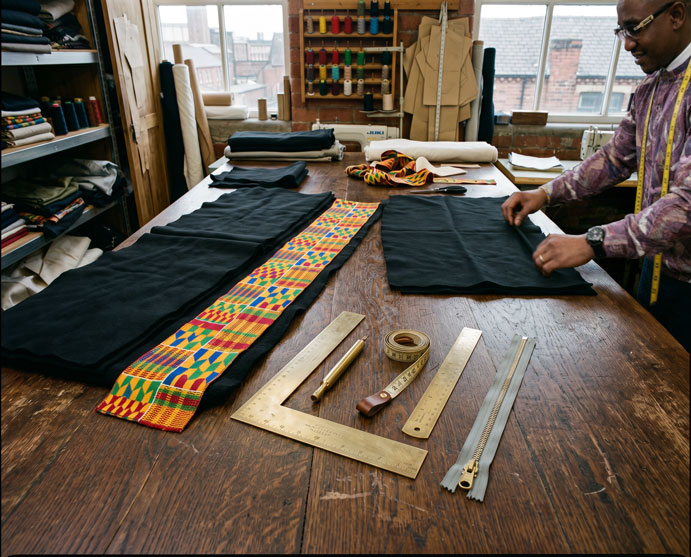
At the Beeston studio, the design methodology approaches this contrast as a creative opportunity rather than a limitation. Through systematic experimentation and bespoke tailoring techniques, artisans split, reinforce, and secure the woven heritage borders into precise anatomical positions on each garment. Whether implementing an asymmetric shoulder sweep on an Eyelet sweatshirt or defining the lateral profile of a luxury tracksuit panel, this combination establishes a distinctive structural dialogue.
The design ethos of King Bro Empire dictates that heritage elements must never serve as mere superficial decoration. They are integrated as essential, load-bearing visual anchors within the architecture of the garment.
Bespoke Tailoring vs. Automated Mass Production
The modern garment market is overwhelmingly dominated by automated, high-velocity factories designed to optimize speed while minimizing variable costs. This systemic optimization requires eliminating irregular, highly complex textile manipulations. Because authentic Kente features unique variations in texture and density, it cannot be processed by standard automated machinery without risking structural tearing or misalignment.
By intentionally adopting an in-house, handmade production model in Leeds, King Bro Empire fundamentally challenges the prevailing factory paradigm. This approach has facilitated collaborations with local artisans, textile innovators, and creative partners who share the brand’s commitment to craftsmanship and heritage. King Bro Empire actively seeks strategic partnerships and investment opportunities with stakeholders interested in advancing sustainable fashion, supporting artisan communities, or co-developing exclusive capsule collections. This operational strategy provides several key advantages for luxury collectors:
- Anatomical Alignment: Each pattern piece is hand-cut and individually matched, ensuring that the complex geometric continuities of the heritage motifs flow seamlessly across garment seams, pockets, and hoods.
- Reinforced Load Points: The intersections where heavy cotton fleece meets structured woven paneling are systematically reinforced with specialized multi-needle lockstitches, preventing the sagging or warping common in factory apparel.
- Hardware Customization: Industrial accents, including heavy-gauge metallic zip-ups, custom-molded drawcord aglets, and strategically positioned eyelet hardware, are meticulously applied by hand, ensuring smooth operation and an exquisite tactile response.
The Beeston, Leeds Design Studio: An Artisan Sanctuary
Leeds has a longstanding legacy as a center of the global textile and tailoring industries. By situating its creative studio in Beeston, King Bro Empire draws upon this heritage of industrial craftsmanship and integrates it with a contemporary, cross-cultural vision. The studio operates not as a high-volume warehouse, but as an elite atelier where garments are developed through rigorous iterative prototyping.
Each commissioned piece or limited-edition design represents an investment in a product that has undergone meticulous oversight throughout its creation. From the initial stress-testing of heavyweight fleece to the final hand-polishing of metallic zippers, the Beeston studio ensures that every garment exemplifies modern garment construction. While King Bro Empire maintains a strong commitment to artisanal excellence, the brand has also established scalable production frameworks that uphold attention to detail as demand increases. Through the training of new artisans, expansion of studio capacity, and refinement of workflow management, King Bro Empire is equipped to accommodate increased orders and strategic partnerships without compromising quality or consistency.
Conclusion: The Future of Exclusivity
As high-end fashion trends increasingly favor conscious, narrative-driven consumption, the distinction between casual apparel and haute couture is blurring. King Bro Empire exemplifies how streetwear can achieve sophistication, cultural celebration, and exceptional structural standards. The brand has established a dedicated following throughout the UK, with garments featured in select boutiques and worn by influential tastemakers in major urban centers. Looking ahead, King Bro Empire aims to expand its market presence across Europe and other strategic global destinations, pursuing collaborations that enhance the visibility of authentically crafted luxury streetwear. By adhering to the principles of the slow fashion movement and emphasizing hand-cut craftsmanship, the brand provides discerning consumers with a distinguished alternative to mass-market apparel. Investing in these garments offers both historical significance and the precision of modern tailoring.